
Rebuilding Trust: Redesigning the Affordable Housing Application Process for the People Who Need It Most
As the lead UX Code for America Fellow working with the Santa Monica Housing Authority (SMHA), I directed and transformed the organization's affordable housing application process through user research. The department's director initially mused, "we need a mobile app."
I proposed running discovery first, and the recommendations that followed — an eligibility screening quiz, a revised website, a separate registration flow for a smaller program, and a workshop and social media plan — were concepts I developed from that research and led through to design.
As the lead UX Code for America Fellow working with the Santa Monica Housing Authority (SMHA), I directed and transformed the organization's affordable housing application process through user research. The department's director initially mused, "we need a mobile app."
I proposed running discovery first, and the recommendations that followed — an eligibility screening quiz, a revised website, a separate registration flow for a smaller program, and a workshop and social media plan — were concepts I developed from that research and led through to design.
Pub Sec
Pub Sec
CivicTech
CivicTech
System Modernization
System Modernization
Multiple Products
Multiple Products
Scenario
My Role
Lead end-to-end Product Designer & Strategist
Lead end-to-end Product Designer & Strategist
Client
Santa Monica Housing Authority, Code for America
Santa Monica Housing Authority, Code for America
Engagement Length
Code for America Fellowship, 2019
Code for America Fellowship, 2019
My Deliverables
Experience Map • Current-State & Proposed Service Blueprints • Personas • Empathy Maps • Section 8 Eligibility Checker • Prototype • Website Sitemap & Content Revisions • Information Architecture • Comparative Research • Workshops • Community Surveys • Process, Research & Recommendations Presentation Decks
Experience Map • Current-State & Proposed Service Blueprints • Personas • Empathy Maps • Section 8 Eligibility Checker • Prototype • Website Sitemap & Content Revisions • Information Architecture • Comparative Research • Workshops • Community Surveys • Process, Research & Recommendations Presentation Decks
A department working with limited resources and an application process that produced a high rejection rate
Before this fellowship, SMHA's Section 8 waitlist process relied on manual staff review and mailed paper applications. Internal data showed that of the pre-applications SMHA had sent out, only about half were ever returned and processed, and of those, roughly 70% were ultimately rejected — most commonly because the applicant was not actually a Santa Monica resident or employee, despite indicating otherwise on the form. Staff described spending significant time verifying applications that would ultimately be deemed ineligible.
At the same time, interviews with community members suggested that residents had limited access to clear information about the program. Several described learning about Section 8 primarily from friends, family, or informal community sources, and said they had difficulty finding useful information on the city's website. Some described distrust of the city, saying they had shared personal information in the past without a clear sense of what happened to it or where their application stood.
No formal research or system-level documentation of this process existed prior to the fellowship. At the outset, the department's working assumption about what this project needed was a mobile app. I proposed a different starting point: run discovery first, and let the direction of the work follow from what staff and residents actually described as the problem, rather than starting from a predetermined solution. That discovery work — which I led, from research plan through synthesis — is what generated the recommendations and prototypes described below. None of the specific concepts (the eligibility-checker approach, the website restructure, the POD registration flow, the social media and workshop program) existed before this research; each one was a concept I developed based on patterns in the interview, survey, and application data.
A department working with limited resources and an application process that produced a high rejection rate
Before this fellowship, SMHA's Section 8 waitlist process relied on manual staff review and mailed paper applications. Internal data showed that of the pre-applications SMHA had sent out, only about half were ever returned and processed, and of those, roughly 70% were ultimately rejected — most commonly because the applicant was not actually a Santa Monica resident or employee, despite indicating otherwise on the form. Staff described spending significant time verifying applications that would ultimately be deemed ineligible.
At the same time, interviews with community members suggested that residents had limited access to clear information about the program. Several described learning about Section 8 primarily from friends, family, or informal community sources, and said they had difficulty finding useful information on the city's website. Some described distrust of the city, saying they had shared personal information in the past without a clear sense of what happened to it or where their application stood.
No formal research or system-level documentation of this process existed prior to the fellowship. At the outset, the department's working assumption about what this project needed was a mobile app. I proposed a different starting point: run discovery first, and let the direction of the work follow from what staff and residents actually described as the problem, rather than starting from a predetermined solution. That discovery work — which I led, from research plan through synthesis — is what generated the recommendations and prototypes described below. None of the specific concepts (the eligibility-checker approach, the website restructure, the POD registration flow, the social media and workshop program) existed before this research; each one was a concept I developed based on patterns in the interview, survey, and application data.
Scope & Challenges
A high application rejection rate. SMHA data indicated most processed applications were rejected, commonly due to residency or income eligibility issues that were not caught until late in the manual review process.
Website information that was difficult to locate. Interviewees generally reported difficulty finding housing information on the city's website; the site's structure had recently changed and did not appear to be organized around resident needs.
Reliance on informal information sources. With no dedicated communication channel from SMHA, several residents said they relied on word of mouth or outside sources, which sometimes provided inaccurate information.
Limited staff capacity. SMHA's team was small relative to its caseload, and any recommendations needed to be implementable without significant new staff time or budget.
Reported distrust of the process. Several community members described skepticism about whether the city would follow up or provide clear next steps after they submitted information.
Scope & Challenges
A high application rejection rate. SMHA data indicated most processed applications were rejected, commonly due to residency or income eligibility issues that were not caught until late in the manual review process.
Website information that was difficult to locate. Interviewees generally reported difficulty finding housing information on the city's website; the site's structure had recently changed and did not appear to be organized around resident needs.
Reliance on informal information sources. With no dedicated communication channel from SMHA, several residents said they relied on word of mouth or outside sources, which sometimes provided inaccurate information.
Limited staff capacity. SMHA's team was small relative to its caseload, and any recommendations needed to be implementable without significant new staff time or budget.
Reported distrust of the process. Several community members described skepticism about whether the city would follow up or provide clear next steps after they submitted information.
Scope & Challenges
A high application rejection rate. SMHA data indicated most processed applications were rejected, commonly due to residency or income eligibility issues that were not caught until late in the manual review process.
Website information that was difficult to locate. Interviewees generally reported difficulty finding housing information on the city's website; the site's structure had recently changed and did not appear to be organized around resident needs.
Reliance on informal information sources. With no dedicated communication channel from SMHA, several residents said they relied on word of mouth or outside sources, which sometimes provided inaccurate information.
Limited staff capacity. SMHA's team was small relative to its caseload, and any recommendations needed to be implementable without significant new staff time or budget.
Reported distrust of the process. Several community members described skepticism about whether the city would follow up or provide clear next steps after they submitted information.
Team Collaboration
Sole UX researcher and designer on this engagement
I was the only designer or researcher working on this project, placed within SMHA's Housing Division as a Code for America Community Fellow. I set the research strategy and methodology, led and conducted the interviews and workshops, and directed how the findings translated into the recommendations and prototypes below. I worked directly with SMHA staff and leadership, and engaged Santa Monica community members through interviews, surveys, and workshops.
MY ROLE: Research Strategy · UX Research · Service Design · Information Architecture · Content · Prototyping · Workshop Facilitation.
SMHA STAFF & LEADERSHIP: Participated in internal interviews, took part in persona and empathy-map exercises during Workshop #1, and reviewed the eligibility-quiz logic and website content.
COMMUNITY MEMBERS: Santa Monica residents, employees, and people who identified as homeless or at risk of losing housing, who participated in interviews, surveys, and group discussions.
COMMUNITY LEADERS & NONPROFIT CONTACTS: Shared perspective on information gaps in the community and helped with survey distribution at local events.
CODE FOR AMERICA FELLOWSHIP PROGRAM: Provided methodology guidance over the course of the fellowship.
Team Collaboration
Sole UX researcher and designer on this engagement
I was the only designer or researcher working on this project, placed within SMHA's Housing Division as a Code for America Community Fellow. I set the research strategy and methodology, led and conducted the interviews and workshops, and directed how the findings translated into the recommendations and prototypes below. I worked directly with SMHA staff and leadership, and engaged Santa Monica community members through interviews, surveys, and workshops.
MY ROLE: Research Strategy · UX Research · Service Design · Information Architecture · Content · Prototyping · Workshop Facilitation.
SMHA STAFF & LEADERSHIP: Participated in internal interviews, took part in persona and empathy-map exercises during Workshop #1, and reviewed the eligibility-quiz logic and website content.
COMMUNITY MEMBERS: Santa Monica residents, employees, and people who identified as homeless or at risk of losing housing, who participated in interviews, surveys, and group discussions.
COMMUNITY LEADERS & NONPROFIT CONTACTS: Shared perspective on information gaps in the community and helped with survey distribution at local events.
CODE FOR AMERICA FELLOWSHIP PROGRAM: Provided methodology guidance over the course of the fellowship.
Team Collaboration
Sole UX researcher and designer on this engagement
I was the only designer or researcher working on this project, placed within SMHA's Housing Division as a Code for America Community Fellow. I set the research strategy and methodology, led and conducted the interviews and workshops, and directed how the findings translated into the recommendations and prototypes below. I worked directly with SMHA staff and leadership, and engaged Santa Monica community members through interviews, surveys, and workshops.
MY ROLE: Research Strategy · UX Research · Service Design · Information Architecture · Content · Prototyping · Workshop Facilitation.
SMHA STAFF & LEADERSHIP: Participated in internal interviews, took part in persona and empathy-map exercises during Workshop #1, and reviewed the eligibility-quiz logic and website content.
COMMUNITY MEMBERS: Santa Monica residents, employees, and people who identified as homeless or at risk of losing housing, who participated in interviews, surveys, and group discussions.
COMMUNITY LEADERS & NONPROFIT CONTACTS: Shared perspective on information gaps in the community and helped with survey distribution at local events.
CODE FOR AMERICA FELLOWSHIP PROGRAM: Provided methodology guidance over the course of the fellowship.


Pivotal Work
Prior to this fellowship, SMHA did not have documented research on how residents or staff experienced the Section 8 process, and there was no shared visual reference for the workflow across the department. The department's initial framing of the project was a mobile app. I set the research plan, led the interviews, surveys, and workshops, and synthesized the findings myself; the direction of the project — away from an app and toward an eligibility-screening tool, revised content, and a documented service process — came out of that synthesis, not from a brief I was handed.
The specific concepts described in this case study (the eligibility-checker approach and its zip-code-based logic, the POD registration flow, the website restructure, and the social media and workshop recommendations) were ones I developed. Some were fully designed and built during the fellowship (the Eligibility Checker, several website pages); others were delivered as prototypes and recommendations (the POD registration flow, the social media and workshop proposals) for SMHA to evaluate and take forward with their own resources and timeline.
Pivotal Work
Prior to this fellowship, SMHA did not have documented research on how residents or staff experienced the Section 8 process, and there was no shared visual reference for the workflow across the department. The department's initial framing of the project was a mobile app. I set the research plan, led the interviews, surveys, and workshops, and synthesized the findings myself; the direction of the project — away from an app and toward an eligibility-screening tool, revised content, and a documented service process — came out of that synthesis, not from a brief I was handed.
The specific concepts described in this case study (the eligibility-checker approach and its zip-code-based logic, the POD registration flow, the website restructure, and the social media and workshop recommendations) were ones I developed. Some were fully designed and built during the fellowship (the Eligibility Checker, several website pages); others were delivered as prototypes and recommendations (the POD registration flow, the social media and workshop proposals) for SMHA to evaluate and take forward with their own resources and timeline.
Pivotal Work
Prior to this fellowship, SMHA did not have documented research on how residents or staff experienced the Section 8 process, and there was no shared visual reference for the workflow across the department. The department's initial framing of the project was a mobile app. I set the research plan, led the interviews, surveys, and workshops, and synthesized the findings myself; the direction of the project — away from an app and toward an eligibility-screening tool, revised content, and a documented service process — came out of that synthesis, not from a brief I was handed.
The specific concepts described in this case study (the eligibility-checker approach and its zip-code-based logic, the POD registration flow, the website restructure, and the social media and workshop recommendations) were ones I developed. Some were fully designed and built during the fellowship (the Eligibility Checker, several website pages); others were delivered as prototypes and recommendations (the POD registration flow, the social media and workshop proposals) for SMHA to evaluate and take forward with their own resources and timeline.
Impact
Section 8 Eligibility Checker, built and launched in English and Spanish, using zip-code verification instead of a self-reported residency checkbox.
Website sitemap revision and content updates across 9+ pages, including Section 8, AHPP, Seniors, and At-Risk/Homeless resources.
A proposed simplified POD registration flow, scoped to POD-specific eligibility questions, delivered as a prototype.
Two workshops conducted with SMHA staff, covering persona and empathy-map development and plain-language content review.
The department's first Community Experience Map and Service Blueprint, visualizing the opaque and complex Section 8 process and all touchpoints, or lack ther of.
Recommendations for a social media presence and recurring public workshops, supported by comparative research across 14 other public housing authorities and community survey data.
Impact
Section 8 Eligibility Checker, built and launched in English and Spanish, using zip-code verification instead of a self-reported residency checkbox.
Website sitemap revision and content updates across 9+ pages, including Section 8, AHPP, Seniors, and At-Risk/Homeless resources.
A proposed simplified POD registration flow, scoped to POD-specific eligibility questions, delivered as a prototype.
Two workshops conducted with SMHA staff, covering persona and empathy-map development and plain-language content review.
The department's first Community Experience Map and Service Blueprint, visualizing the opaque and complex Section 8 process and all touchpoints, or lack ther of.
Recommendations for a social media presence and recurring public workshops, supported by comparative research across 14 other public housing authorities and community survey data.
Impact
Section 8 Eligibility Checker, built and launched in English and Spanish, using zip-code verification instead of a self-reported residency checkbox.
Website sitemap revision and content updates across 9+ pages, including Section 8, AHPP, Seniors, and At-Risk/Homeless resources.
A proposed simplified POD registration flow, scoped to POD-specific eligibility questions, delivered as a prototype.
Two workshops conducted with SMHA staff, covering persona and empathy-map development and plain-language content review.
The department's first Community Experience Map and Service Blueprint, visualizing the opaque and complex Section 8 process and all touchpoints, or lack ther of.
Recommendations for a social media presence and recurring public workshops, supported by comparative research across 14 other public housing authorities and community survey data.
Process
Discovery
Interviews with staff and community members, plus a review of existing application data
I conducted a set of interviews with SMHA staff to understand their day-to-day process, and a separate set of interviews and group discussions with community members to understand how they experienced trying to access housing assistance. I also reviewed SMHA's existing Section 8 pre-application data.
12 Internal Staff Interviews · 7 External Community Interviews · 4 Group & Event Discussions · 4 Community Surveys · 2 Staff Workshops
An observation from the research
The application data showed that a large share of pre-applicants who indicated they were local residents or employees were not. Staff also described this as a recurring source of wasted review time. I treated this as the central problem to design around, and it's the specific data point that led me to the eligibility-checker concept, rather than the mobile app the department had initially assumed it needed.
"The problem isn't the engagement itself, our problem isn't a lack of applicants — the problem is the lack of applicants that meet the narrow criteria. Related to that, our process is complicated and not very user-friendly." SMHA Staff Member
"Searching for affordable housing info was difficult, I couldn't find anything so I gave up. Their website is horrible, doesn't give you any information and is nonsensical." Community Member
Discovery
Interviews with staff and community members, plus a review of existing application data
I conducted a set of interviews with SMHA staff to understand their day-to-day process, and a separate set of interviews and group discussions with community members to understand how they experienced trying to access housing assistance. I also reviewed SMHA's existing Section 8 pre-application data.
12 Internal Staff Interviews · 7 External Community Interviews · 4 Group & Event Discussions · 4 Community Surveys · 2 Staff Workshops
An observation from the research
The application data showed that a large share of pre-applicants who indicated they were local residents or employees were not. Staff also described this as a recurring source of wasted review time. I treated this as the central problem to design around, and it's the specific data point that led me to the eligibility-checker concept, rather than the mobile app the department had initially assumed it needed.
"The problem isn't the engagement itself, our problem isn't a lack of applicants — the problem is the lack of applicants that meet the narrow criteria. Related to that, our process is complicated and not very user-friendly." SMHA Staff Member
"Searching for affordable housing info was difficult, I couldn't find anything so I gave up. Their website is horrible, doesn't give you any information and is nonsensical." Community Member
Discovery
Interviews with staff and community members, plus a review of existing application data
I conducted a set of interviews with SMHA staff to understand their day-to-day process, and a separate set of interviews and group discussions with community members to understand how they experienced trying to access housing assistance. I also reviewed SMHA's existing Section 8 pre-application data.
12 Internal Staff Interviews · 7 External Community Interviews · 4 Group & Event Discussions · 4 Community Surveys · 2 Staff Workshops
An observation from the research
The application data showed that a large share of pre-applicants who indicated they were local residents or employees were not. Staff also described this as a recurring source of wasted review time. I treated this as the central problem to design around, and it's the specific data point that led me to the eligibility-checker concept, rather than the mobile app the department had initially assumed it needed.
"The problem isn't the engagement itself, our problem isn't a lack of applicants — the problem is the lack of applicants that meet the narrow criteria. Related to that, our process is complicated and not very user-friendly." SMHA Staff Member
"Searching for affordable housing info was difficult, I couldn't find anything so I gave up. Their website is horrible, doesn't give you any information and is nonsensical." Community Member
19
Interviews
19
Interviews
4
On-Site Research
4
On-Site Research
2
Workshops
2
Workshops
4
Surveys
4
Surveys
4
Surveys
1
Service Blueprint
1
Service Blueprint
1
Service Blueprint
1
Experience Maps
1
Experience Maps
1
Experience Maps
1
Presentations
1
Presentations
1
Presentations

Definition
Documenting the process and the people in it
I synthesized the interview, survey, and application data into a set of research artifacts, which I designed to document what I'd learned and to give SMHA a shared reference for the process as it existed:
Community Experience Map: A visualization of how residents described discovering, understanding, and attempting to access SMHA's services, based on interview and survey findings.
Current-State Service Blueprint (Section 8): A map of the existing Section 8 process, including resident actions, staff actions, systems involved, and points where interviewees described friction.
Service Blueprint with Proposed Additions: A version of the blueprint showing where the recommendations that follow could fit into the existing workflow.
Personas & Empathy Maps: Developed with SMHA staff during Workshop #1, based on interview data, representing different groups of residents and applicants the department worked with.
Comparative research
I reviewed how a sample of 14 other public housing authorities — including NYC, Chicago, Boston, Houston, Philadelphia, Austin, and HACLA — used social media, structured their websites, and formatted their Section 8 pre-applications. This research was used as a reference point when designing the eligibility quiz and website content, and as supporting material when presenting the social media and workshop recommendations to SMHA leadership.
Definition
Documenting the process and the people in it
I synthesized the interview, survey, and application data into a set of research artifacts, which I designed to document what I'd learned and to give SMHA a shared reference for the process as it existed:
Community Experience Map: A visualization of how residents described discovering, understanding, and attempting to access SMHA's services, based on interview and survey findings.
Current-State Service Blueprint (Section 8): A map of the existing Section 8 process, including resident actions, staff actions, systems involved, and points where interviewees described friction.
Service Blueprint with Proposed Additions: A version of the blueprint showing where the recommendations that follow could fit into the existing workflow.
Personas & Empathy Maps: Developed with SMHA staff during Workshop #1, based on interview data, representing different groups of residents and applicants the department worked with.
Comparative research
I reviewed how a sample of 14 other public housing authorities — including NYC, Chicago, Boston, Houston, Philadelphia, Austin, and HACLA — used social media, structured their websites, and formatted their Section 8 pre-applications. This research was used as a reference point when designing the eligibility quiz and website content, and as supporting material when presenting the social media and workshop recommendations to SMHA leadership.
Definition
Documenting the process and the people in it
I synthesized the interview, survey, and application data into a set of research artifacts, which I designed to document what I'd learned and to give SMHA a shared reference for the process as it existed:
Community Experience Map: A visualization of how residents described discovering, understanding, and attempting to access SMHA's services, based on interview and survey findings.
Current-State Service Blueprint (Section 8): A map of the existing Section 8 process, including resident actions, staff actions, systems involved, and points where interviewees described friction.
Service Blueprint with Proposed Additions: A version of the blueprint showing where the recommendations that follow could fit into the existing workflow.
Personas & Empathy Maps: Developed with SMHA staff during Workshop #1, based on interview data, representing different groups of residents and applicants the department worked with.
Comparative research
I reviewed how a sample of 14 other public housing authorities — including NYC, Chicago, Boston, Houston, Philadelphia, Austin, and HACLA — used social media, structured their websites, and formatted their Section 8 pre-applications. This research was used as a reference point when designing the eligibility quiz and website content, and as supporting material when presenting the social media and workshop recommendations to SMHA leadership.
Readout
A set of prioritized recommendations
Based on my synthesis of the research, I defined and prioritized four areas of work — none of which had been proposed or scoped before this project:
Section 8 Eligibility Checker — a self-service tool intended to help residents understand their likely eligibility before submitting a full application.
Website Content & Information Architecture — revised page structure and content aimed at making basic information easier to find.
Dedicated SMHA Social Media — a proposed channel for posting updates and addressing misinformation.
Community Workshops — proposed recurring sessions to share information directly with residents, community leaders, and nonprofit partners.
I presented these recommendations to SMHA staff in Workshop #2, along with a plain-language exercise in which staff reviewed and discussed examples of client letters the department had previously sent.
Readout
A set of prioritized recommendations
Based on my synthesis of the research, I defined and prioritized four areas of work — none of which had been proposed or scoped before this project:
Section 8 Eligibility Checker — a self-service tool intended to help residents understand their likely eligibility before submitting a full application.
Website Content & Information Architecture — revised page structure and content aimed at making basic information easier to find.
Dedicated SMHA Social Media — a proposed channel for posting updates and addressing misinformation.
Community Workshops — proposed recurring sessions to share information directly with residents, community leaders, and nonprofit partners.
I presented these recommendations to SMHA staff in Workshop #2, along with a plain-language exercise in which staff reviewed and discussed examples of client letters the department had previously sent.
Readout
A set of prioritized recommendations
Based on my synthesis of the research, I defined and prioritized four areas of work — none of which had been proposed or scoped before this project:
Section 8 Eligibility Checker — a self-service tool intended to help residents understand their likely eligibility before submitting a full application.
Website Content & Information Architecture — revised page structure and content aimed at making basic information easier to find.
Dedicated SMHA Social Media — a proposed channel for posting updates and addressing misinformation.
Community Workshops — proposed recurring sessions to share information directly with residents, community leaders, and nonprofit partners.
I presented these recommendations to SMHA staff in Workshop #2, along with a plain-language exercise in which staff reviewed and discussed examples of client letters the department had previously sent.

Usability Testing
Feedback gathered through workshops, surveys, and community conversations
I did not have access to a formal usability testing environment or budget, so I gathered feedback through the touchpoints available: staff workshops, community surveys, and conversations at community group meetings and events.
In Workshop #1, SMHA staff built empathy maps and reviewed an early version of the eligibility quiz logic. I also shared quiz prototypes with community members at local group meetings before finalizing the content.
Four community surveys, distributed at local events, provided additional feedback:
90.9% of respondents said they would use a Section 8 eligibility quiz if one were available.
72.7% said they would follow SMHA on social media.
63.6% said they would attend a housing workshop.
These results were generally consistent with what I heard in interviews, and were shared with SMHA staff and leadership alongside the recommendations.
Usability Testing
Feedback gathered through workshops, surveys, and community conversations
I did not have access to a formal usability testing environment or budget, so I gathered feedback through the touchpoints available: staff workshops, community surveys, and conversations at community group meetings and events.
In Workshop #1, SMHA staff built empathy maps and reviewed an early version of the eligibility quiz logic. I also shared quiz prototypes with community members at local group meetings before finalizing the content.
Four community surveys, distributed at local events, provided additional feedback:
90.9% of respondents said they would use a Section 8 eligibility quiz if one were available.
72.7% said they would follow SMHA on social media.
63.6% said they would attend a housing workshop.
These results were generally consistent with what I heard in interviews, and were shared with SMHA staff and leadership alongside the recommendations.
Usability Testing
Feedback gathered through workshops, surveys, and community conversations
I did not have access to a formal usability testing environment or budget, so I gathered feedback through the touchpoints available: staff workshops, community surveys, and conversations at community group meetings and events.
In Workshop #1, SMHA staff built empathy maps and reviewed an early version of the eligibility quiz logic. I also shared quiz prototypes with community members at local group meetings before finalizing the content.
Four community surveys, distributed at local events, provided additional feedback:
90.9% of respondents said they would use a Section 8 eligibility quiz if one were available.
72.7% said they would follow SMHA on social media.
63.6% said they would attend a housing workshop.
These results were generally consistent with what I heard in interviews, and were shared with SMHA staff and leadership alongside the recommendations.

Designs
Prototypes and content produced during the fellowship
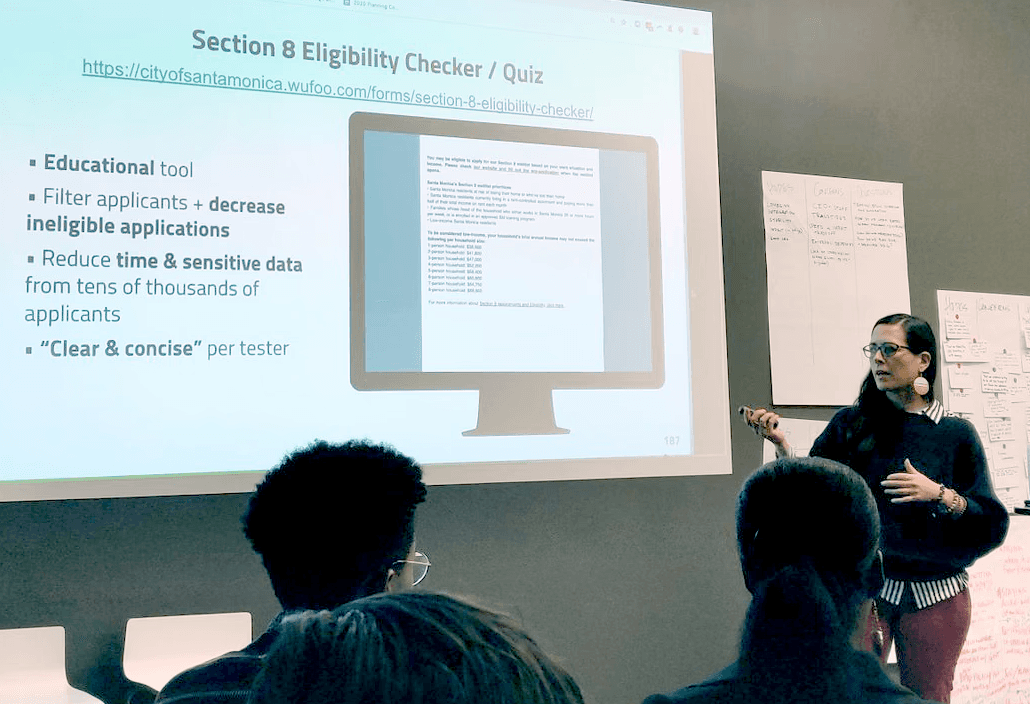
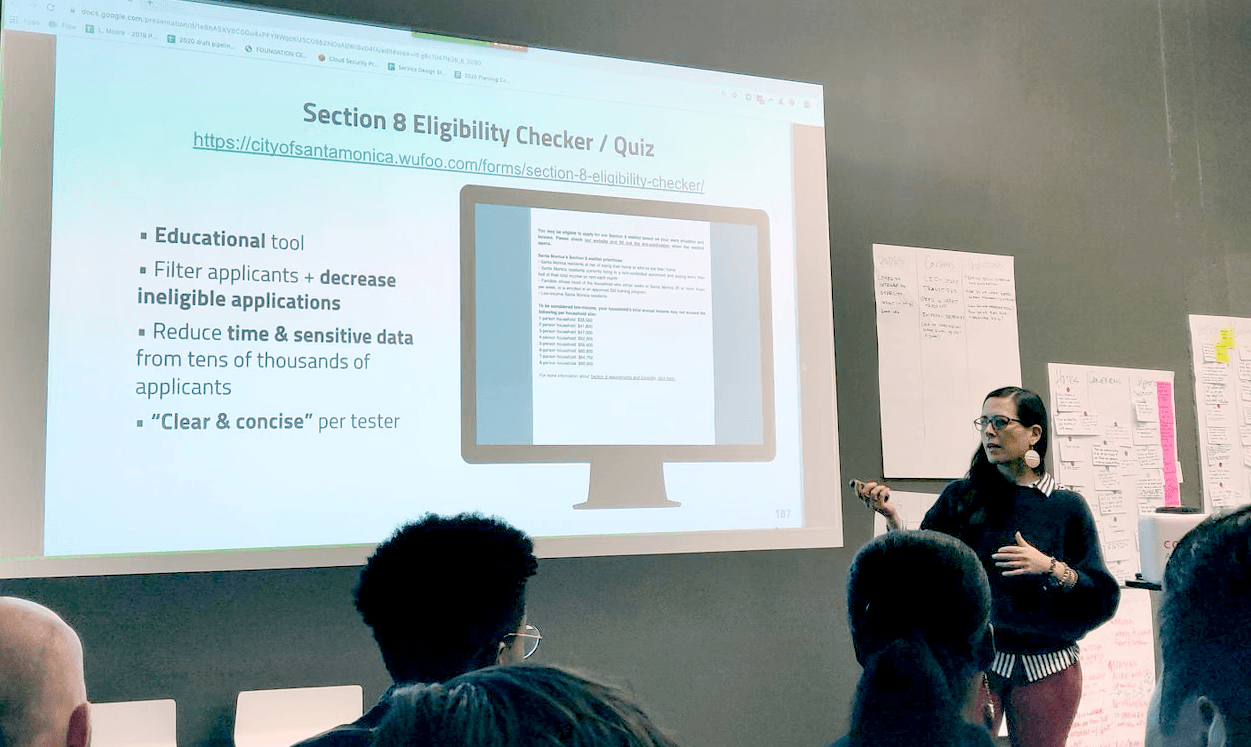
Section 8 Eligibility Checker. This was a concept I originated during discovery, not a solution the department had asked for or scoped in advance — the initial assumption going into the project had been that it needed a mobile app. I designed and built a five-page quiz in Wufoo, available in English and Spanish. The quiz asks for a zip code (home and work) rather than using a self-reported yes/no checkbox for residency, which was the format used on the existing application; I made that substitution directly based on the finding that many applicants checked "yes" to residency questions regardless of accuracy. I also designed the branching logic — based on residency, employment, income, and household size — and wrote a tailored response for each outcome (eligible, over-income, non-resident, homeless, at-risk of losing housing).
POD Registration Prototype. SMHA's "Preserving Our Diversity" (POD) program has narrower eligibility requirements than Section 8, but at the time, interested applicants would have needed to use the full Section 8 pre-application within SMHA's HAPPY case-management system. I identified this mismatch during research and designed a simplified, separate registration flow scoped to POD's specific eligibility questions, intended to reduce the amount of information collected from applicants and the amount staff would need to review. This flow did not exist prior to this project.
Website Content & Information Architecture. I proposed and implemented a revised sitemap and rewrote or created several pages, including Section 8 (in English and Spanish), the Moderate Income Housing Program (AHPP), Seniors, At-Risk/Homeless resources, and POD. Changes included plain-language rewrites, FAQ-style anchor links, and more consistent visual structure and sub-navigation across pages.
Social Media & Workshop Recommendations. I put together recommendations for a social media presence and a recurring workshop program, including example content types and a proposed workshop curriculum (an overview of Section 8 eligibility, how to complete the pre-application, and an overview of SMHA's other programs), based on the comparative research and survey findings.
Designs
Prototypes and content produced during the fellowship
Section 8 Eligibility Checker. This was a concept I originated during discovery, not a solution the department had asked for or scoped in advance — the initial assumption going into the project had been that it needed a mobile app. I designed and built a five-page quiz in Wufoo, available in English and Spanish. The quiz asks for a zip code (home and work) rather than using a self-reported yes/no checkbox for residency, which was the format used on the existing application; I made that substitution directly based on the finding that many applicants checked "yes" to residency questions regardless of accuracy. I also designed the branching logic — based on residency, employment, income, and household size — and wrote a tailored response for each outcome (eligible, over-income, non-resident, homeless, at-risk of losing housing).
POD Registration Prototype. SMHA's "Preserving Our Diversity" (POD) program has narrower eligibility requirements than Section 8, but at the time, interested applicants would have needed to use the full Section 8 pre-application within SMHA's HAPPY case-management system. I identified this mismatch during research and designed a simplified, separate registration flow scoped to POD's specific eligibility questions, intended to reduce the amount of information collected from applicants and the amount staff would need to review. This flow did not exist prior to this project.
Website Content & Information Architecture. I proposed and implemented a revised sitemap and rewrote or created several pages, including Section 8 (in English and Spanish), the Moderate Income Housing Program (AHPP), Seniors, At-Risk/Homeless resources, and POD. Changes included plain-language rewrites, FAQ-style anchor links, and more consistent visual structure and sub-navigation across pages.
Social Media & Workshop Recommendations. I put together recommendations for a social media presence and a recurring workshop program, including example content types and a proposed workshop curriculum (an overview of Section 8 eligibility, how to complete the pre-application, and an overview of SMHA's other programs), based on the comparative research and survey findings.
Designs
Prototypes and content produced during the fellowship
Section 8 Eligibility Checker. This was a concept I originated during discovery, not a solution the department had asked for or scoped in advance — the initial assumption going into the project had been that it needed a mobile app. I designed and built a five-page quiz in Wufoo, available in English and Spanish. The quiz asks for a zip code (home and work) rather than using a self-reported yes/no checkbox for residency, which was the format used on the existing application; I made that substitution directly based on the finding that many applicants checked "yes" to residency questions regardless of accuracy. I also designed the branching logic — based on residency, employment, income, and household size — and wrote a tailored response for each outcome (eligible, over-income, non-resident, homeless, at-risk of losing housing).
POD Registration Prototype. SMHA's "Preserving Our Diversity" (POD) program has narrower eligibility requirements than Section 8, but at the time, interested applicants would have needed to use the full Section 8 pre-application within SMHA's HAPPY case-management system. I identified this mismatch during research and designed a simplified, separate registration flow scoped to POD's specific eligibility questions, intended to reduce the amount of information collected from applicants and the amount staff would need to review. This flow did not exist prior to this project.
Website Content & Information Architecture. I proposed and implemented a revised sitemap and rewrote or created several pages, including Section 8 (in English and Spanish), the Moderate Income Housing Program (AHPP), Seniors, At-Risk/Homeless resources, and POD. Changes included plain-language rewrites, FAQ-style anchor links, and more consistent visual structure and sub-navigation across pages.
Social Media & Workshop Recommendations. I put together recommendations for a social media presence and a recurring workshop program, including example content types and a proposed workshop curriculum (an overview of Section 8 eligibility, how to complete the pre-application, and an overview of SMHA's other programs), based on the comparative research and survey findings.
Outcome
Application data and interviews pointed to different but related issues. The rejection-rate data on its own could have suggested a stricter verification process. The interviews suggested the underlying issue was more about confusion and lack of clear information, which shaped the direction toward self-service and educational tools rather than stricter gatekeeping.
Tooling choices were shaped by SMHA's capacity. I built the Eligibility Checker in Wufoo rather than proposing custom development, since SMHA did not have engineering resources or an ongoing budget, and staff would need to be able to maintain it after the fellowship ended.
Website changes were only one part of the information problem. Interviews suggested that unclear content and a difficult-to-navigate site were part of why residents struggled to find information, but distrust and reliance on informal sources were separate, related issues that content changes alone would not fully address.
Feedback collection had to work within existing constraints. Without a dedicated research budget or testing environment, workshops, staff review sessions, and community surveys were the main ways I gathered feedback on the recommendations and prototypes before the end of the fellowship.
Outcome
Application data and interviews pointed to different but related issues. The rejection-rate data on its own could have suggested a stricter verification process. The interviews suggested the underlying issue was more about confusion and lack of clear information, which shaped the direction toward self-service and educational tools rather than stricter gatekeeping.
Tooling choices were shaped by SMHA's capacity. I built the Eligibility Checker in Wufoo rather than proposing custom development, since SMHA did not have engineering resources or an ongoing budget, and staff would need to be able to maintain it after the fellowship ended.
Website changes were only one part of the information problem. Interviews suggested that unclear content and a difficult-to-navigate site were part of why residents struggled to find information, but distrust and reliance on informal sources were separate, related issues that content changes alone would not fully address.
Feedback collection had to work within existing constraints. Without a dedicated research budget or testing environment, workshops, staff review sessions, and community surveys were the main ways I gathered feedback on the recommendations and prototypes before the end of the fellowship.
Outcome
Application data and interviews pointed to different but related issues. The rejection-rate data on its own could have suggested a stricter verification process. The interviews suggested the underlying issue was more about confusion and lack of clear information, which shaped the direction toward self-service and educational tools rather than stricter gatekeeping.
Tooling choices were shaped by SMHA's capacity. I built the Eligibility Checker in Wufoo rather than proposing custom development, since SMHA did not have engineering resources or an ongoing budget, and staff would need to be able to maintain it after the fellowship ended.
Website changes were only one part of the information problem. Interviews suggested that unclear content and a difficult-to-navigate site were part of why residents struggled to find information, but distrust and reliance on informal sources were separate, related issues that content changes alone would not fully address.
Feedback collection had to work within existing constraints. Without a dedicated research budget or testing environment, workshops, staff review sessions, and community surveys were the main ways I gathered feedback on the recommendations and prototypes before the end of the fellowship.
